Move AI

Women in History Who Shaped Mobility

Highlighting women whose contributions helped shape the transportation, accessibility and mobility systems used today.

5 min read

In recognition of Women’s History Month, we are highlighting several women whose contributions helped shape transportation, accessibility, and mobility systems used today. From early automotive innovation to civil rights advocacy and accessibility policy, their work continues to influence industries that depend on reliable transportation.
International Women’s Day: Women in History Who Shaped Mobility
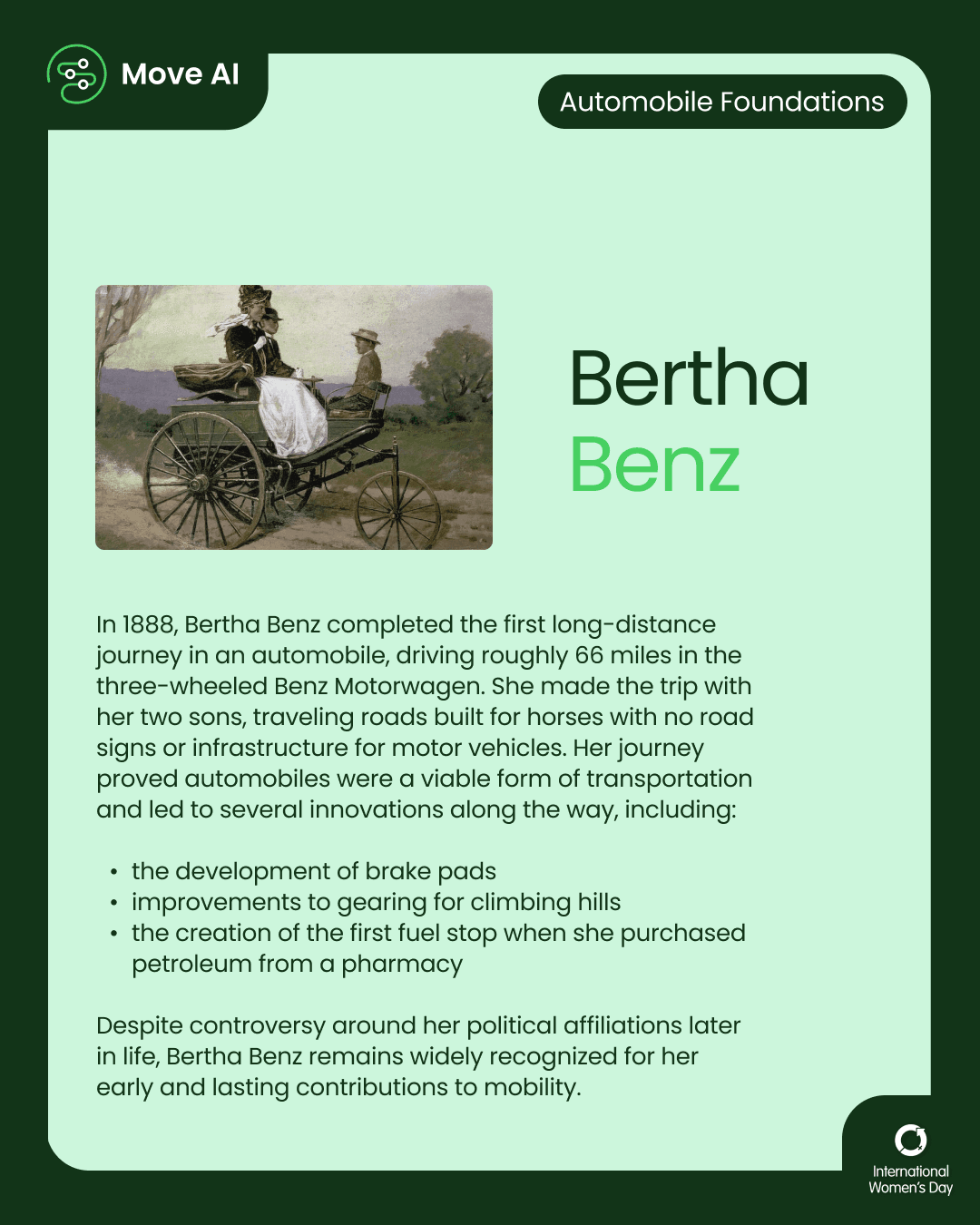
Automobile Foundations. Bertha Benz: In 1888, Bertha Benz completed the first long-distance journey in an automobile, driving roughly 66 miles in the three-wheeled Benz Motorwagen. She made the trip with her two sons, traveling roads built for horses with no road signs or infrastructure for motor vehicles. Her journey proved automobiles were a viable form of transportation and led to several innovations along the way, including the development of brake pads, improvements to gearing for climbing hills, and the creation of the first fuel stop when she purchased petroleum from a pharmacy. Despite controversy around her political affiliations later in life, Bertha Benz remains widely recognized for her early and lasting contributions to mobility.
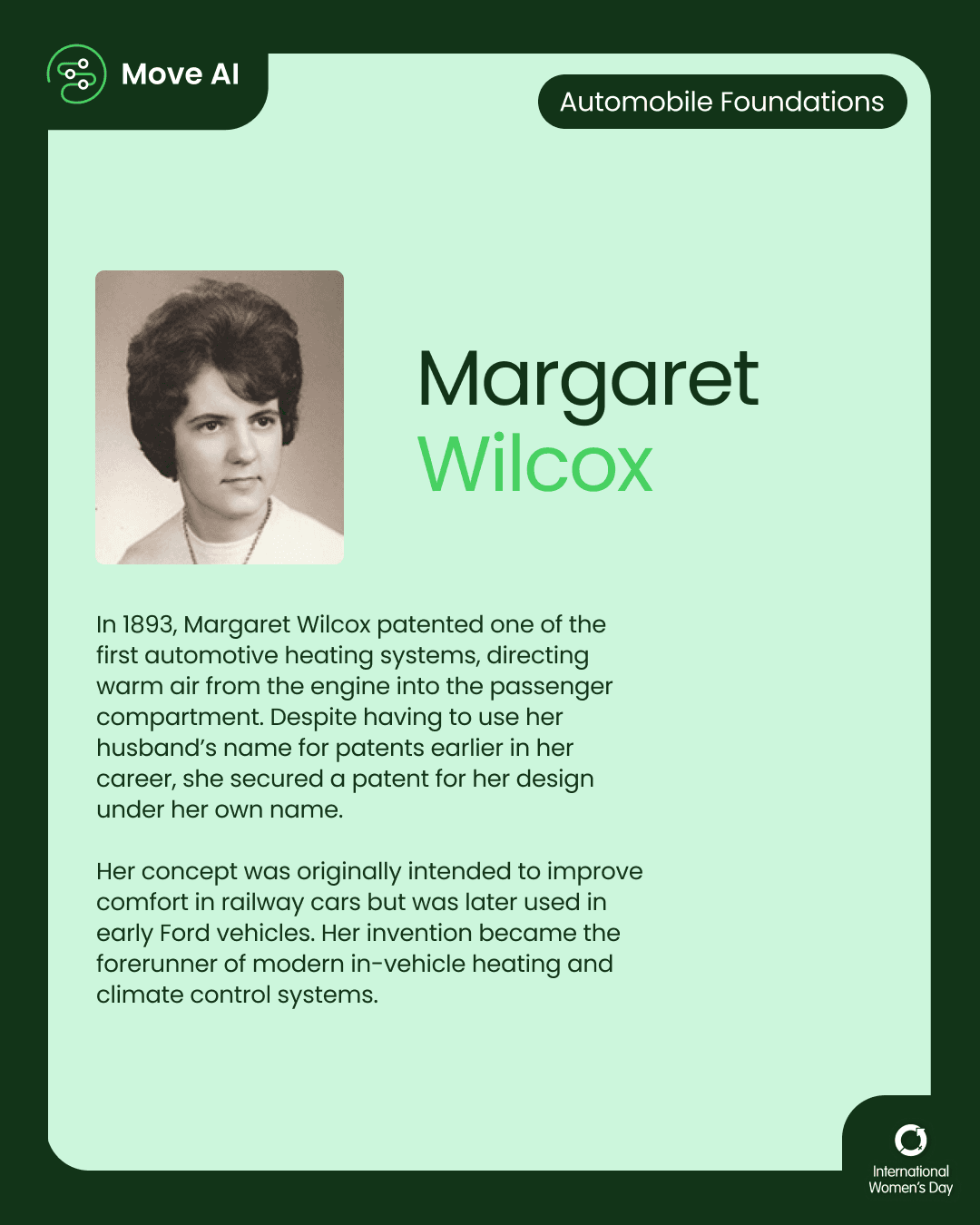
Automobile Foundations. Margaret Wilcox: In 1893, Margaret Wilcox patented one of the first automotive heating systems, directing warm air from the engine into the passenger compartment. Despite having to use her husband’s name for patents earlier in her career, she secured a patent for her design under her own name. Her concept was originally intended to improve comfort in railway cars but was later used in early Ford vehicles. Her invention became the forerunner of modern in-vehicle heating and climate control systems.
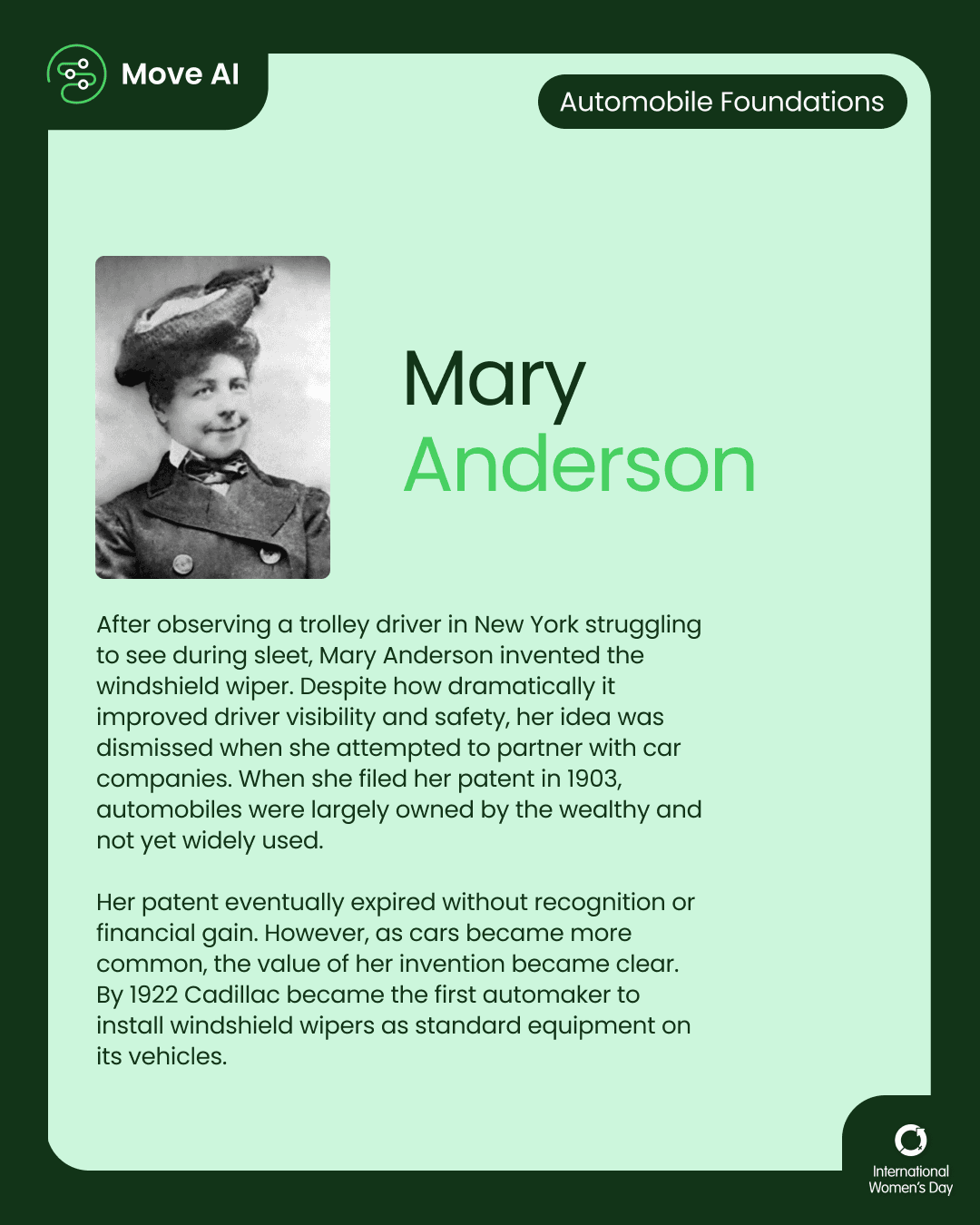
Automobile Foundations. Mary Anderson: After observing a trolley driver in New York struggling to see during sleet, Mary Anderson invented the windshield wiper. Despite how dramatically it improved driver visibility and safety, her idea was dismissed when she attempted to partner with car companies. When she filed her patent in 1903, automobiles were largely owned by the wealthy and not yet widely used. Her patent eventually expired without recognition or financial gain. However, as cars became more common, the value of her invention became clear. By 1922 Cadillac became the first automaker to install windshield wipers as standard equipment on its vehicles.
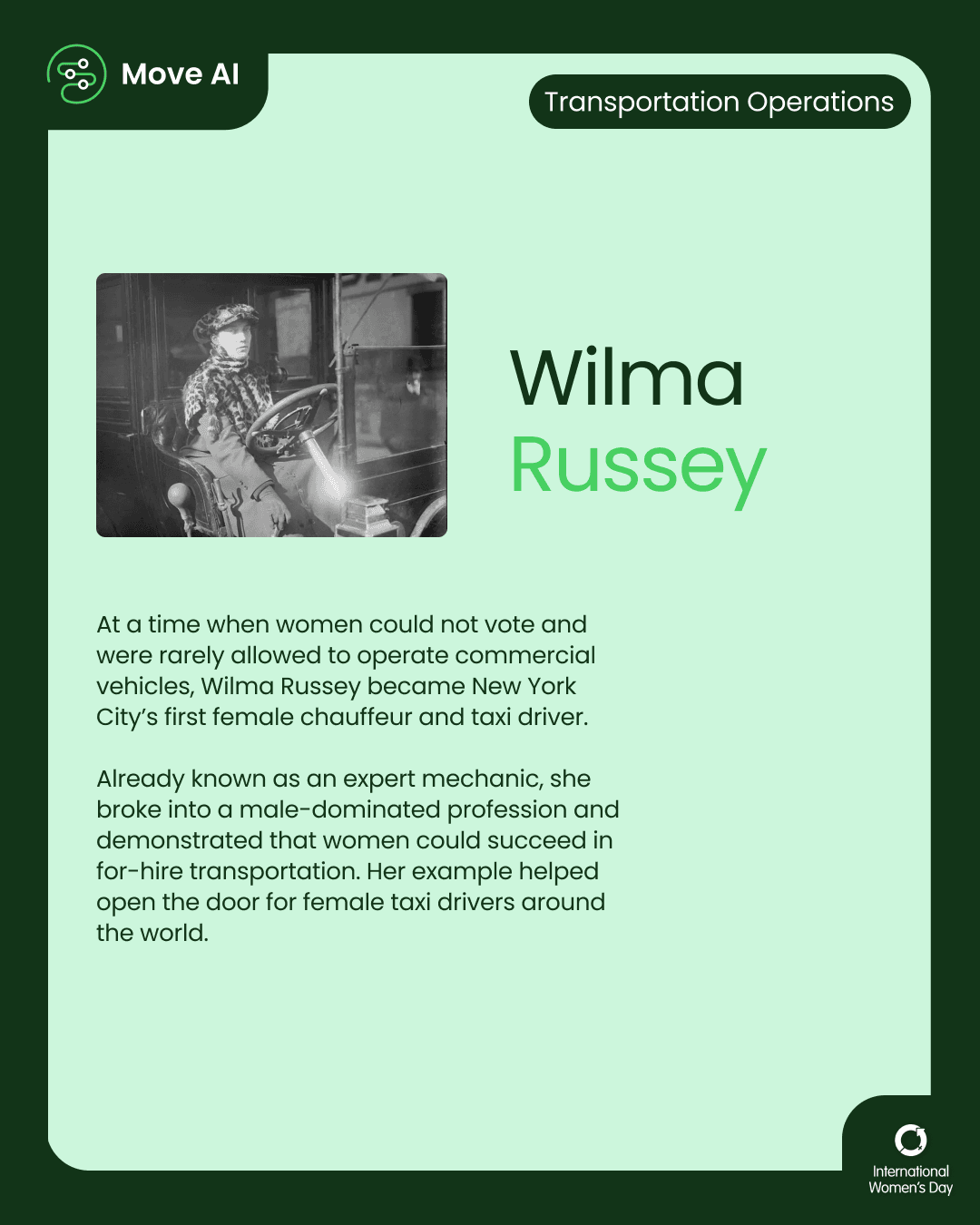
Transportation Operations. Wilma Russey: At a time when women could not vote and were rarely allowed to operate commercial vehicles, Wilma Russey became New York City’s first female chauffeur and taxi driver. Already known as an expert mechanic, she broke into a male-dominated profession and demonstrated that women could succeed in for-hire transportation. Her example helped open the door for female taxi drivers around the world.
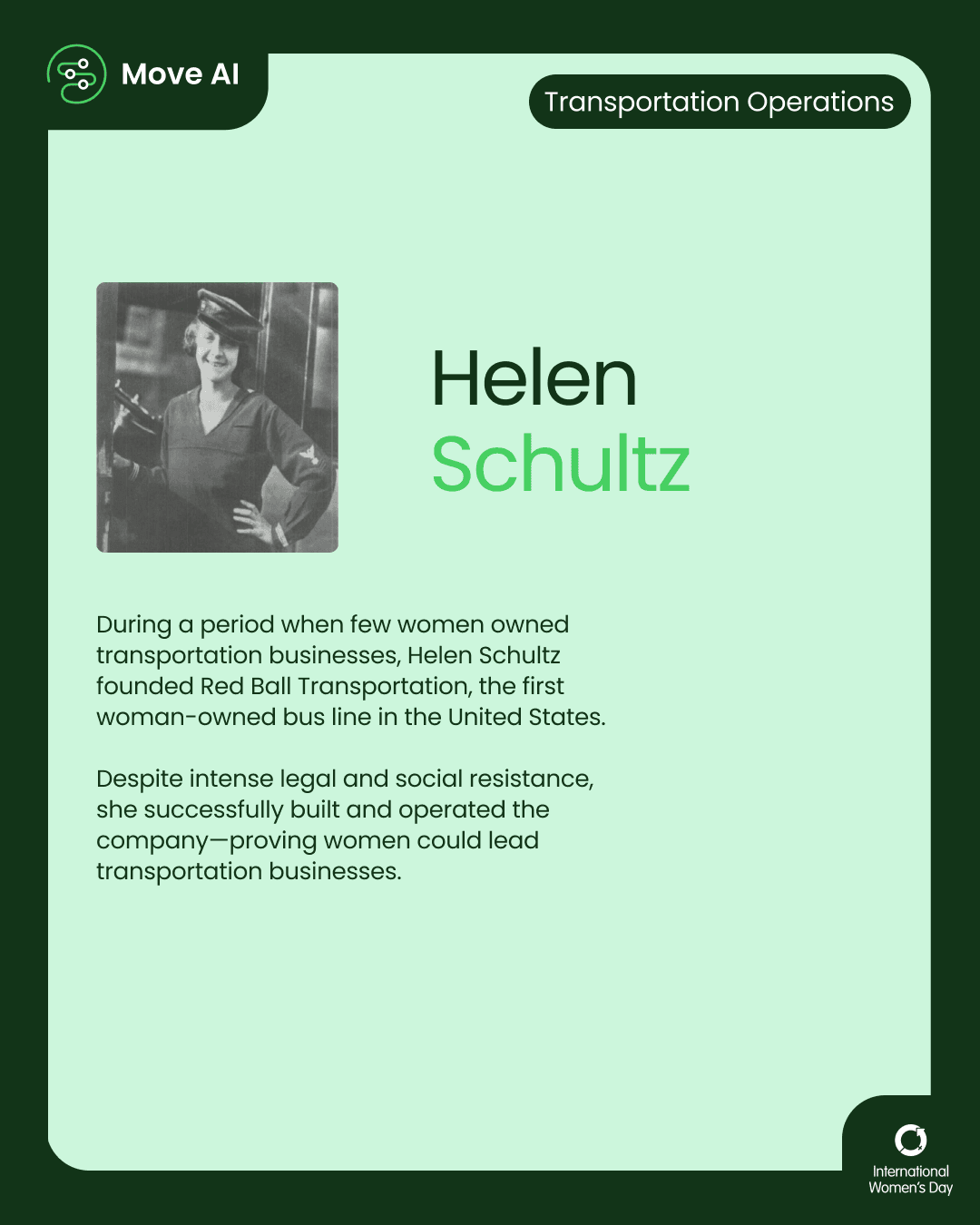
Transportation Operations. Helen Schultz: During a period when few women owned transportation businesses, Helen Schultz founded Red Ball Transportation, the first woman-owned bus line in the United States. Despite intense legal and social resistance, she successfully built and operated the company—proving women could lead transportation businesses.
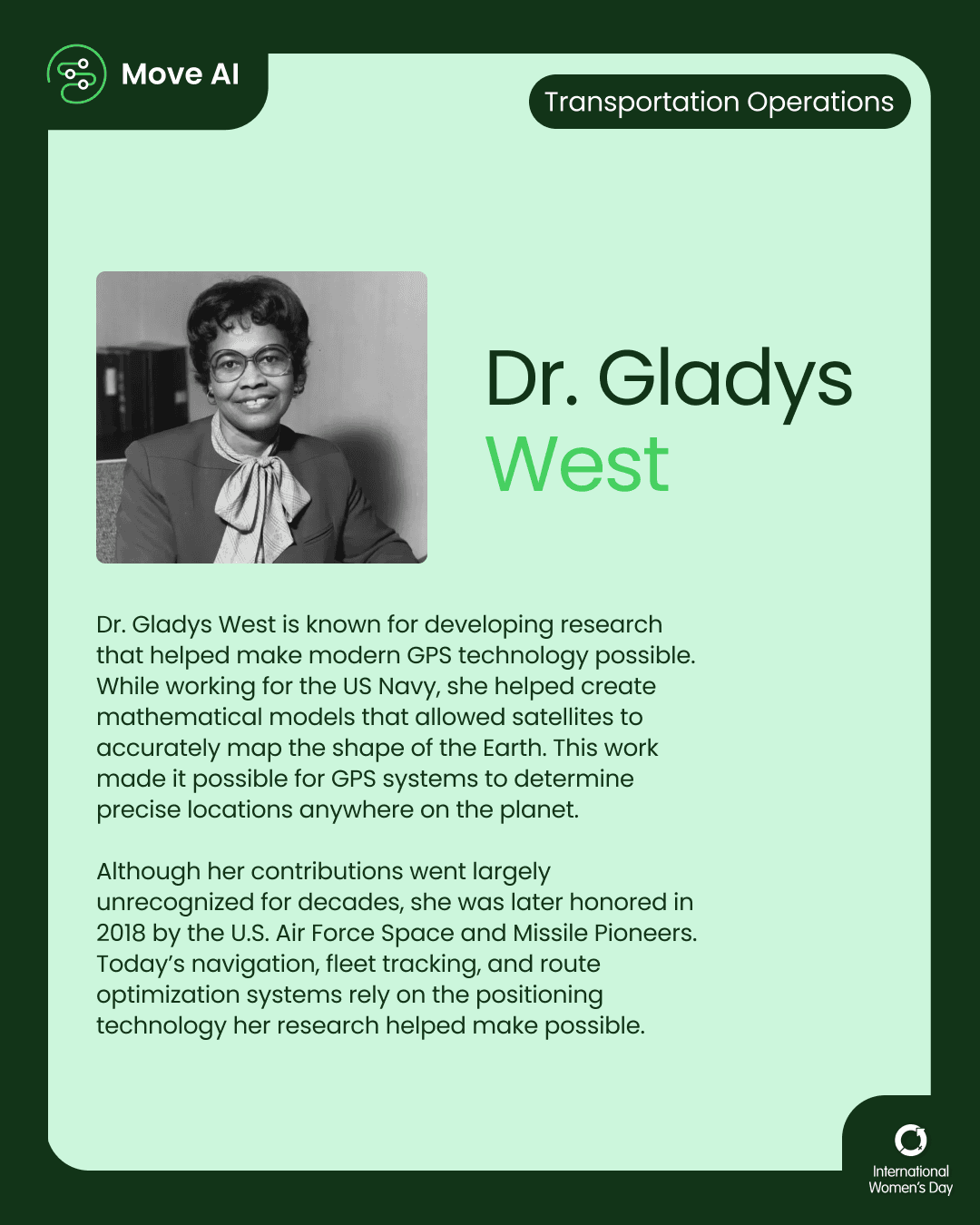
Transportation Operations. Dr. Gladys West: Dr. Gladys West is known for developing research that helped make modern GPS technology possible. While working for the US Navy, she helped create mathematical models that allowed satellites to accurately map the shape of the Earth. This work made it possible for GPS systems to determine precise locations anywhere on the planet. Although her contributions went largely unrecognized for decades, she was later honored in 2018 by the U.S. Air Force Space and Missile Pioneers. Today’s navigation, fleet tracking, and route optimization systems rely on the positioning technology her research helped make possible.
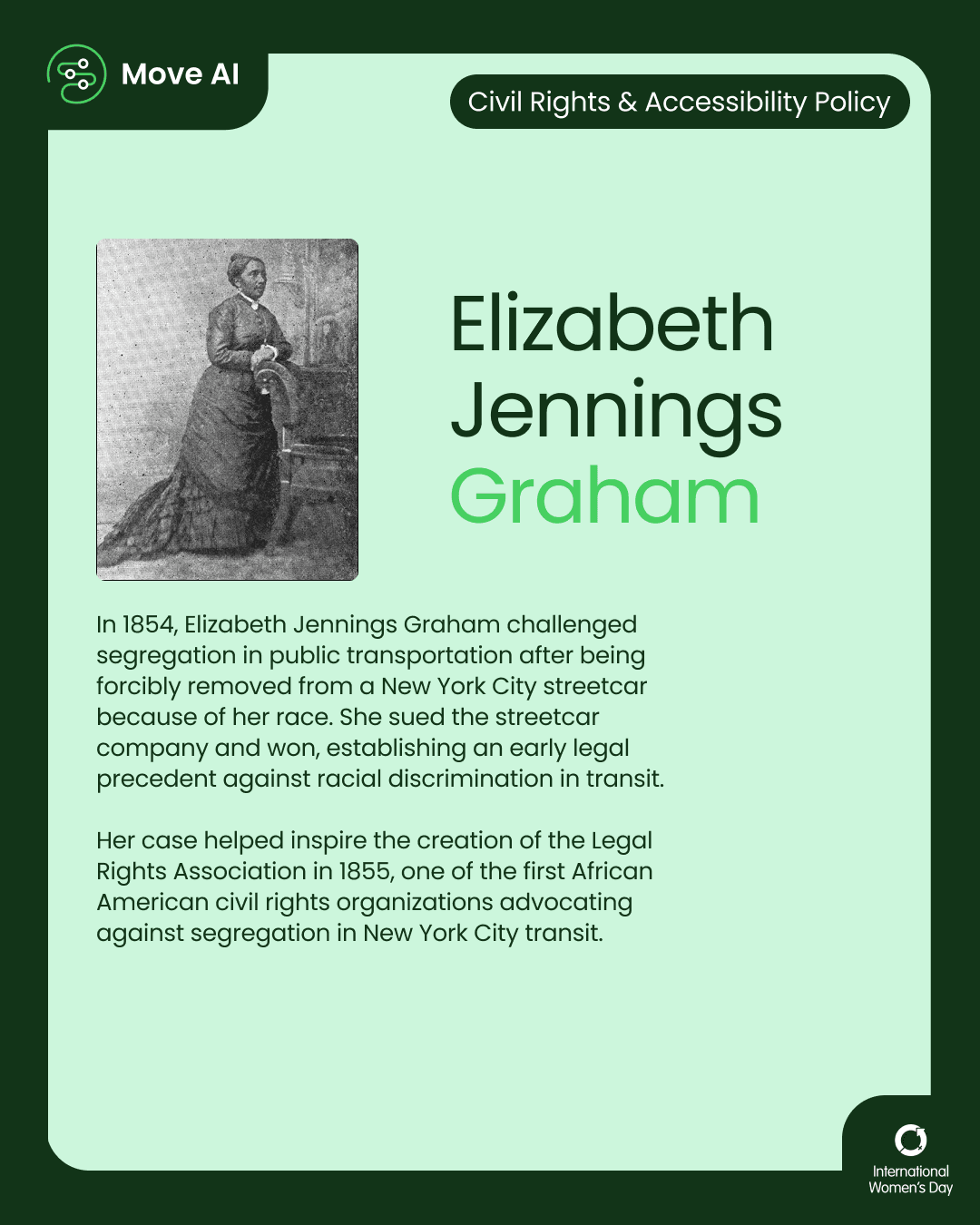
Civil Rights & Accessibility Policy. Elizabeth Jennings Graham: In 1854, Elizabeth Jennings Graham challenged segregation in public transportation after being forcibly removed from a New York City streetcar because of her race. She sued the streetcar company and won, establishing an early legal precedent against racial discrimination in transit. Her case helped inspire the creation of the Legal Rights Association in 1855, one of the first African American civil rights organizations advocating against segregation in New York City transit.
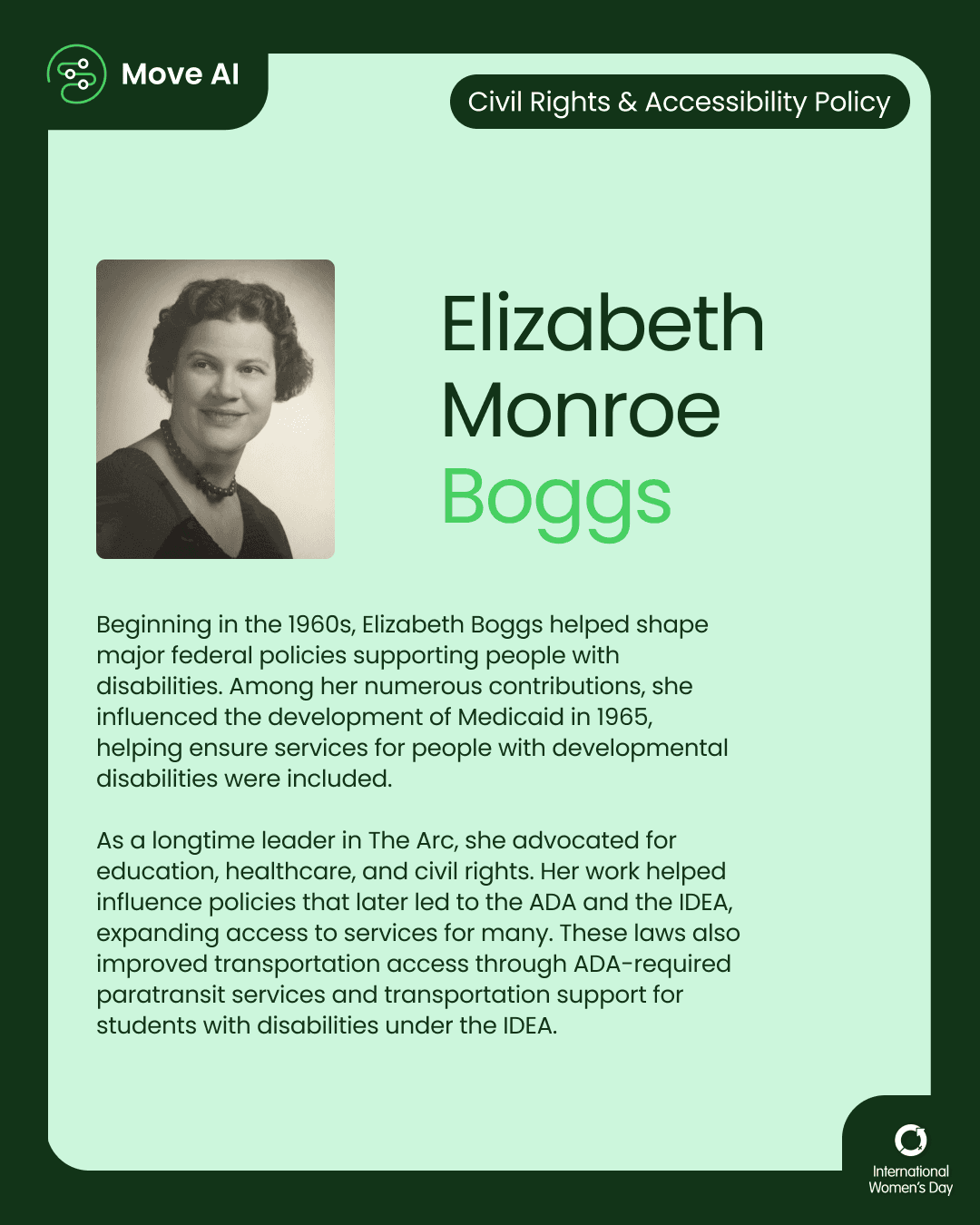
Civil Rights & Accessibility Policy. Elizabeth Monroe Boggs: Beginning in the 1960s, Elizabeth Boggs helped shape major federal policies supporting people with disabilities. Among her numerous contributions, she influenced the development of Medicaid in 1965, helping ensure services for people with developmental disabilities were included. As a longtime leader in The Arc, she advocated for education, healthcare, and civil rights. Her work helped influence policies that later led to the ADA and the IDEA, expanding access to services for many. These laws also improved transportation access through ADA-required paratransit services and transportation support for students with disabilities under the IDEA.
Civil Rights & Accessibility Policy. Marilyn Golden: For decades, disability rights advocate Marilyn Golden worked to strengthen accessibility protections under the ADA. As a senior policy analyst at the Disability Rights Education and Defense Fund (DREDF), she helped shape and defend accessibility provisions within the law. Her work supported requirements for wheelchair ramps and other accommodations in buildings, public spaces, and transit systems including buses and rail. Among her many contributions, her efforts helped improve mobility and access for people with disabilities across everyday life.
These pioneers represent only a small part of the women who have shaped mobility throughout history. Today, many women are continuing to make powerful contributions across the industry. As more females enter fields like engineering, mobility technology, policy and related areas, the next generation of innovators will continue to expand access and opportunity.

Slide 1 / 11

Explore more blogs